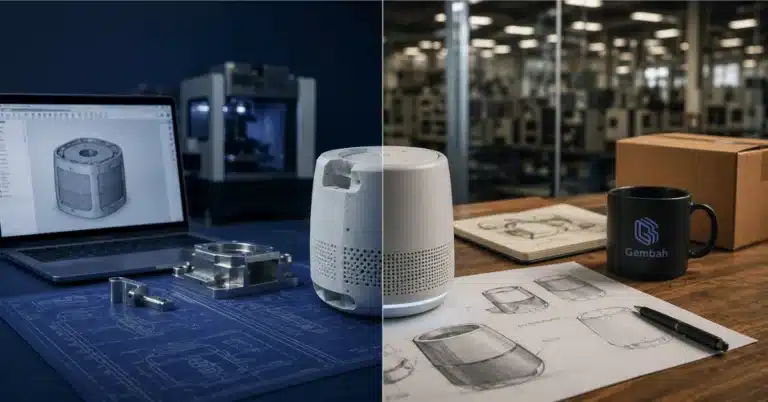
The Gembah vs Dragon Sourcing comparison turns on one question: do you need a product developed, or a product procured? Both help you get goods made overseas, but they sit at different points in the journey. Dragon Sourcing is a procurement and sourcing agency that finds, vets, and manages suppliers for products you have already specified. Gembah is an end-to-end product development partner that designs, engineers, sources, and manufactures the product itself.
That distinction decides everything else. If your product is finished and you need a factory found and managed, a procurement agency is built for that. If your product still needs to be designed and engineered to be manufacturable, that is a different job, and it is the one Gembah is built for. Hiring a procurement agency to develop a product, or a development partner to do simple procurement, is how founders end up paying for the wrong scope.
This guide compares the two on model, ideal user, engineering support, and pricing transparency, and shows the exact handoff point between them.
Also Read:
TL;DR
Gembah and Dragon Sourcing solve different problems. Dragon Sourcing, founded in 2004, is a procurement and sourcing agency that identifies suppliers across roughly 50 countries, then negotiates, audits, inspects, and manages logistics for products you have already designed. Gembah is an end-to-end product development partner that handles research, design, engineering, sourcing, and managed manufacturing. Choose a procurement agency when you have a finished, production-ready spec and just need a supplier found and managed. Choose Gembah when you need to develop or engineer the product itself, want transparent factory pricing, and want one accountable team from concept to production.
Key Points
- Develop versus procure. Gembah develops products; Dragon Sourcing procures them. That is the core difference.
- Different starting points. Dragon Sourcing assumes a finished spec; Gembah starts at the idea.
- Engineering support. Design and engineering are core to Gembah and outside a procurement agency’s scope.
- Pricing transparency. Sourcing agents can mark up factory prices invisibly, so confirm the model directly.
- IP considerations. Owning the development relationship affects how your intellectual property is protected.
- Footprint versus depth. Dragon Sourcing spans roughly 50 countries for procurement; Gembah runs a vetted network of more than 2,000 factories with managed manufacturing.
- The handoff point is clear. A finished spec fits procurement; a product still being developed fits Gembah.
Not sure whether you need development or procurement? Tell us where your product stands and we will point you to the right model, even when that is the smaller engagement. Talk to a Gembah expert.
What Is Dragon Sourcing?
Dragon Sourcing is a procurement and sourcing services provider that helps organizations buy goods from emerging and developed markets. Founded in 2004, it has built offices across Asia, Africa, Eastern Europe, Turkey, Mexico, and South America, with access to suppliers in roughly 50 countries.
Its service model is procurement in the professional sense: supplier identification, supplier audits, commercial negotiation, pre-shipment inspection, quality control, and logistics coordination. That is a substantial and valuable offering, and for the right buyer it is exactly the right tool.
The best fit is a buyer or organization that already knows what product it wants made and needs professional supplier sourcing and management to get it. Dragon Sourcing is built to procure a defined product well, not to invent one.
What Is Gembah?
Gembah is an end-to-end product development and manufacturing platform. It takes a product from research and design through engineering, sourcing, and managed manufacturing, rather than starting from a finished spec.
The network spans more than 2,000 vetted factories with Gembah teams in China, Vietnam, India, Mexico, and the United States, plus contacts in many more. Pricing is transparent, so brands see the real factory cost, and quality control is managed in process and at final inspection.
The best fit is a brand or entrepreneur developing a product, not just procuring an existing one. If your starting point is an idea or an early concept rather than a production-ready specification, you are in Gembah’s lane.
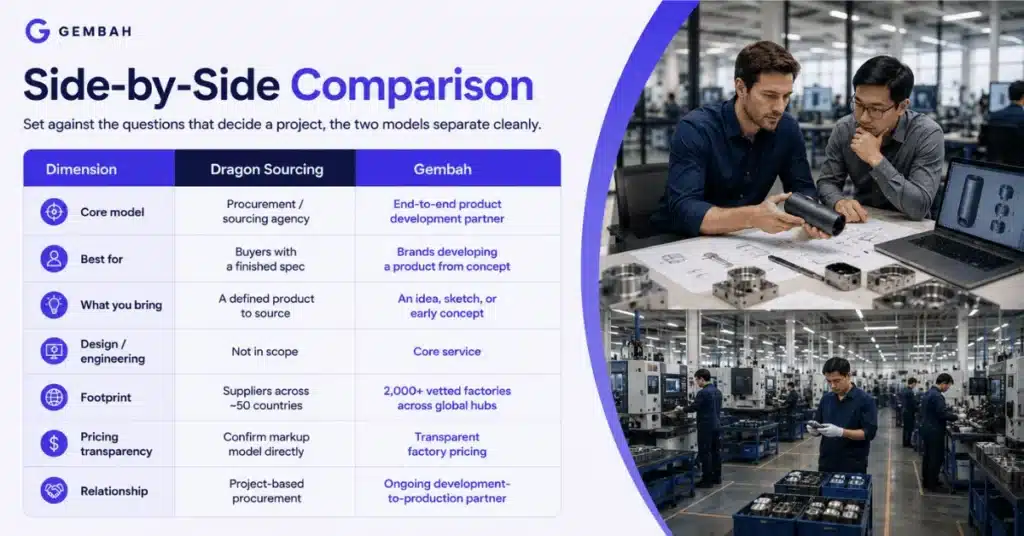
Side-by-Side Comparison
Set against the questions that decide a project, the two models separate cleanly.
| Dimension | Dragon Sourcing | Gembah |
| Core model | Procurement / sourcing agency | End-to-end product development partner |
| Best for | Buyers with a finished spec | Brands developing a product from concept |
| What you bring | A defined product to source | An idea, sketch, or early concept |
| Design / engineering | Not in scope | Core service |
| Footprint | Suppliers across ~50 countries | 2,000+ vetted factories across global hubs |
| Pricing transparency | Confirm markup model directly | Transparent factory pricing |
| Relationship | Project-based procurement | Ongoing development-to-production partner |
When to Choose Dragon Sourcing (or a Procurement Agency)
A procurement agency is the right call in a specific set of situations. Reach for one when:
- You have a finished, production-ready product and only need a supplier found, vetted, and managed.
- You are an established organization with internal product and engineering teams and are outsourcing procurement.
- You need broad, multi-category procurement across many countries.
- You want supplier audits, negotiation, and inspection delivered as a discrete service.
In those cases, paying for full product development would be paying for work you have already done in-house. Procurement is the leaner, more appropriate scope.
When to Choose Gembah
Gembah is the right call when the product itself still needs to be built. Reach for it when:
- You have an idea or early concept, not a finished spec.
- You need design and engineering to make the product real and manufacturable.
- You want transparent factory pricing instead of an opaque agent markup.
- You want one accountable team from concept to production, with country diversification handled for you.
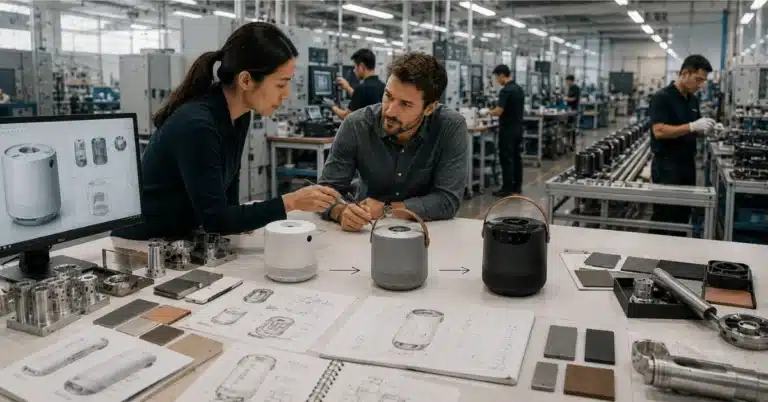
Design and engineering are not add-ons here. They are the core of the work, because most of a product’s eventual cost and manufacturability is decided long before the first purchase order. Design-stage choices lock in roughly 70 to 80 percent of a product’s eventual cost, and MIT Professional Education reports that as many as 95 percent of new products miss the mark, often because that work happened too late or not at all. Our breakdown of a product development company versus a sourcing agent walks through this distinction in more depth.
That country diversification is not a hypothetical nicety in 2026. The Tax Foundation’s tariff tracker shows US rates moving repeatedly through the year, US goods imports from China fell nearly 30 percent in 2025 according to the Bureau of Economic Analysis, and Deloitte’s 2026 Manufacturing Industry Outlook reports nearshoring momentum building. A development partner that already spans multiple countries can move with those changes instead of scrambling after them.
Need a product built, not just sourced? Get a transparent, project-scoped quote with a clear path from concept to production. Get a quote from Gembah.
The Pricing Transparency Question
This is the part of any procurement or sourcing conversation worth slowing down for. The common sourcing-agent model is a markup on the real factory price. The agent quotes you a number that already includes their margin, and you may never see the underlying factory cost. Industry reporting on sourcing model options in China lays out how these fee structures typically work.
Transparency matters for three reasons. It affects your unit economics, because a hidden markup is a permanent tax on every order. It affects trust, because you cannot verify a price you cannot see. And it affects your ability to negotiate, because you are negotiating blind.
Gembah’s position is transparent factory pricing inside a managed relationship, so brands see the real cost alongside the project fee. That is not a knock on every agency, and a reputable one will tell you its model when you ask. The point is to ask directly which model any partner uses, and to get the answer in writing before the first order. We cover the brand-side stakes in detail in what brands need to know about sourcing agents.
How Gembah Fits
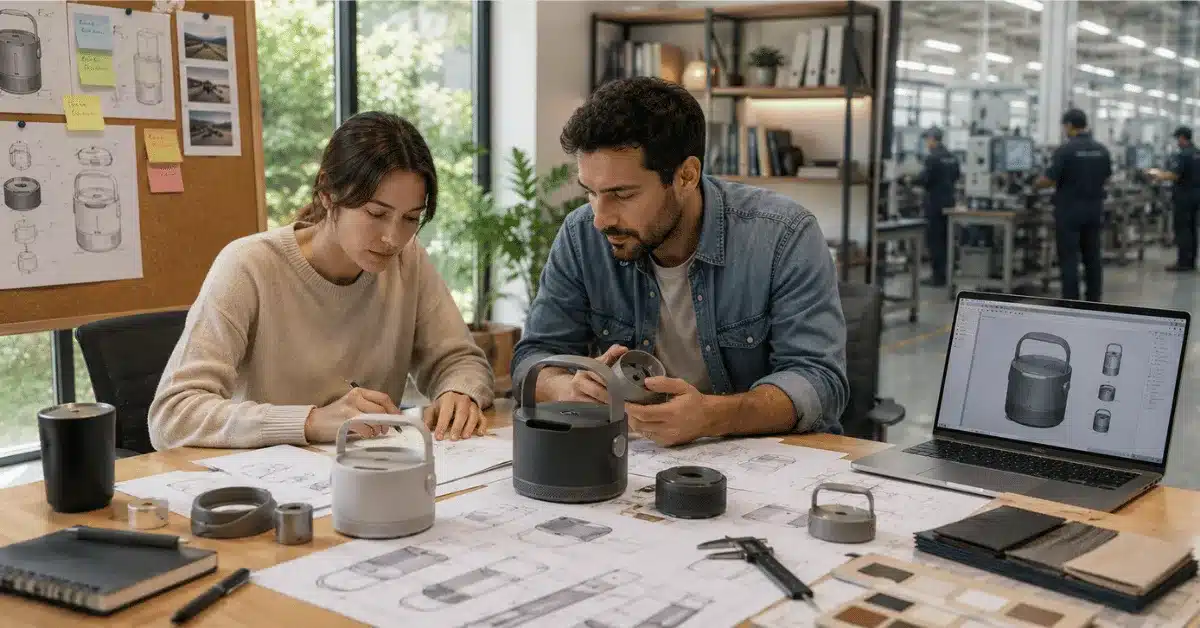
Gembah covers the full journey: design, engineering, sourcing, and managed manufacturing under one accountable team. That is the difference between procuring a product and developing one, and it shows up in the outcomes.
Bella & Co. is a clear example. The brand used Gembah’s factory-led model to turn a home-preservation problem into a patented, eco-friendly pet product, modifying existing factory tooling to reach a unique, protectable design without the six-figure cost of new molds, and reaching market in roughly half the usual time. The full Bella & Co. case study shows what end-to-end product development looks like when design, engineering, and sourcing sit with one team rather than spread across an agency and a separate design firm.
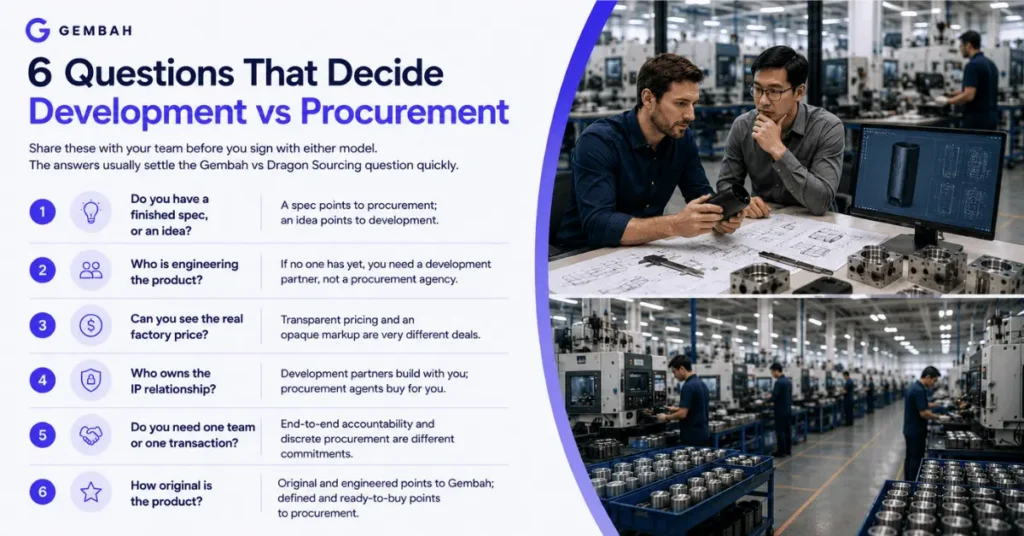
6 Questions That Decide Development vs Procurement
Share these with your team before you sign with either model. The answers usually settle the Gembah vs Dragon Sourcing question quickly.
- Do you have a finished spec, or an idea? A spec points to procurement; an idea points to development.
- Who is engineering the product? If no one has yet, you need a development partner, not a procurement agency.
- Can you see the real factory price? Transparent pricing and an opaque markup are very different deals.
- Who owns the IP relationship? Development partners build with you; procurement agents buy for you.
- Do you need one team or one transaction? End-to-end accountability and discrete procurement are different commitments.
- How original is the product? Original and engineered points to Gembah; defined and ready-to-buy points to procurement.
Frequently Asked Questions
What is the difference between Gembah and Dragon Sourcing?
Dragon Sourcing is a procurement agency that sources and manages suppliers for products you have already designed. Gembah is an end-to-end partner that develops, engineers, and manufactures the product itself. One procures a defined product; the other builds an original one.
Is Gembah a Dragon Sourcing alternative?
It is an alternative if you need product development, not just procurement. For pure, multi-category procurement of finished specs across many countries, the two serve genuinely different needs and a procurement agency may be the better fit.
Do sourcing agencies mark up factory prices?
Some do, and the markup may be invisible to the buyer. It is not inherently wrong, but it does affect your unit economics, so ask any partner directly about their pricing model and get the answer in writing before your first order.
Which is better for a startup or new brand?
A brand still developing or engineering its product usually needs an end-to-end partner like Gembah rather than a procurement agency, because the product has to be made manufacturable before a supplier can be managed against it.
Conclusion
The choice comes down to develop versus procure. A finished spec that needs a supplier found and managed fits a procurement agency. A product that still needs to be developed and engineered fits Gembah. Neither is better in the abstract; they are tools for different jobs.
The deciding factors are product stage, engineering need, pricing transparency, intellectual property, and accountability. Weigh those honestly and the right model is usually clear. Gembah’s end-to-end approach, transparent factory pricing, and vetted multi-country network exist for the brands whose answer is “I have a product to build, not just buy.”
Need a product built, not just sourced? Talk to a Gembah expert and get a clear path from concept to production. Get started with Gembah.